08.07.2026
By Trydan Tech Team

Industrial energy infrastructure is under more pressure than at any point in recent memory. Across manufacturing facilities, data centers, telecom networks, and renewable energy projects, the demand for reliable, scalable, and cost-predictable power has outpaced what traditional grid connections and diesel backup systems can deliver. Battery energy storage systems have moved from an emerging option to an engineering necessity, and the procurement teams and project engineers responsible for specifying them are navigating a market crowded with competing architectures, chemistries, and performance claims.
Getting the specification right matters more than most initial evaluations suggest. A system that appears cost-competitive on capital expenditure alone can become a liability within five years if degradation rates were underestimated, if thermal management was deprioritized, or if the architecture does not support the maintenance and expansion requirements of a long-lived industrial deployment. The goal of this post is to give engineers and procurement professionals a technically grounded framework for evaluating BESS solutions, with a focus on the architectural and electrochemical decisions that determine whether a system performs as designed across its full operational life. For teams currently evaluating options, more information on Trydan Tech's BESS product range is available at www.trydantech.com.
Understanding why certain BESS architectures consistently outperform others in field deployments requires looking at how design decisions at the component and system level interact over time. Three variables dominate long-term BESS performance: bus voltage architecture, cell chemistry, and thermal management quality. Each decision made in these areas compounds across thousands of operating cycles and ultimately determines whether a system meets its projected levelized cost of storage or falls short of it.
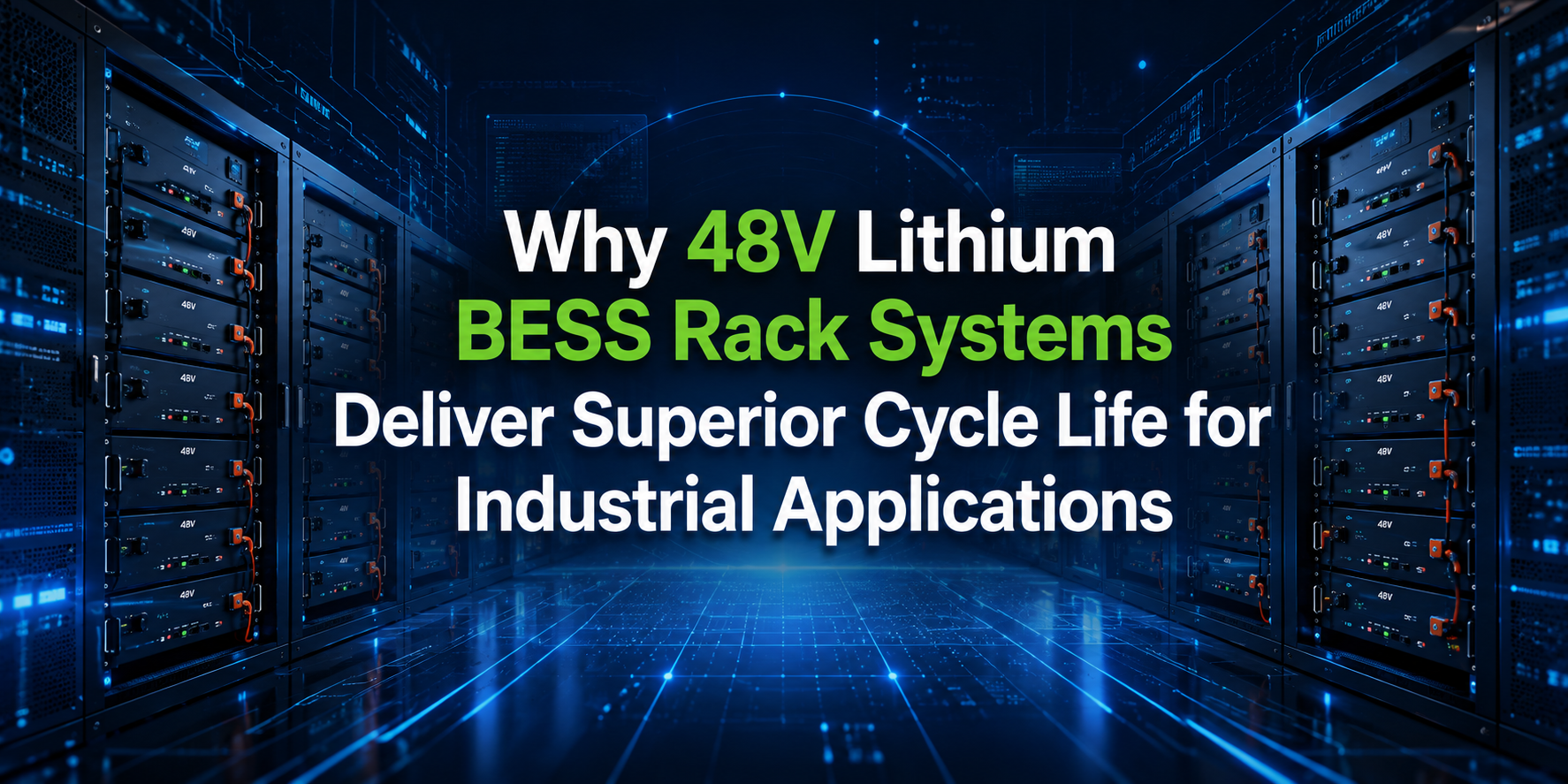
The 48V bus voltage standard has become the preferred architecture for modular stationary storage deployments, and for well-documented engineering reasons. At 48V nominal, each rack module operates as a self-contained unit with its own battery management system, protection relays, thermal sensors, and communication stack. When a project requires greater capacity, additional racks are paralleled at the DC bus level rather than extending a series string. This distinction is significant. Series string architectures propagate imbalance across every cell in the chain, and a single degraded cell can reduce the effective capacity and efficiency of the entire string. A 48V lithium BESS rack system eliminates this failure mode by design. Each rack's BMS manages only the cells within that rack, maintaining tighter voltage and temperature control across a smaller, more manageable cell population.
The practical maintenance implications of this architecture are substantial. When a fault occurs in a rack-based system, it is contained at the rack boundary. The affected rack can be isolated and removed while adjacent racks continue delivering power to the load. In a high-voltage series string, the same fault typically requires a full system shutdown, a complete string discharge, and manual identification of the problem cell or module. For industrial operators running around-the-clock loads or providing contracted backup power to critical infrastructure, unplanned downtime of that nature has direct financial consequences.
Scalability is the second operational advantage of the rack-based approach. A 48V lithium BESS rack system can be expanded by adding racks to the parallel bus without modifying existing hardware, rewriting firmware, or requalifying the installed system. This makes phased deployment strategies genuinely viable. An initial installation can be sized to meet current requirements, with a clear and low-friction upgrade path as site energy needs grow. Procurement teams working within capital expenditure constraints will recognize this as a meaningful structural advantage over monolithic high-voltage systems that must be replaced rather than expanded.
Cell chemistry determines the electrochemical ceiling of what any architecture can achieve. Lithium iron phosphate, or LFP, has emerged as the standard chemistry for stationary BESS applications because its performance profile aligns directly with the demands of industrial deployment. The olivine crystal structure of the LFP cathode resists the lattice degradation that limits cycle life in nickel manganese cobalt and other intercalation chemistries. LFP cells do not exhibit the thermal runaway propagation risks associated with higher-energy-density alternatives, which simplifies both thermal management system design and regulatory compliance in enclosed installations.
A properly engineered long cycle life BESS battery built on LFP chemistry, with active cell balancing and a calibrated BMS, can deliver more than 6,000 full cycles to 80 percent depth of discharge under controlled thermal conditions. At one full cycle per day, that exceeds 16 years of operation before the system reaches its end-of-warranty capacity threshold. That figure is a direct consequence of the electrochemical stability of LFP under cyclic stress, not a marketing claim. Engineers reviewing datasheets should request cycle testing data at multiple temperatures and discharge rates, not just the best-case laboratory result, to understand how performance holds under conditions representative of the actual deployment environment.
Thermal management is where field performance most frequently diverges from laboratory projections. Cell degradation accelerates non-linearly with temperature. A system that operates at an average cell temperature 10 degrees above its optimal range may consume cycle life at twice the rate suggested by standard test data. The rack-based architecture supports better thermal management by isolating each rack as an independent thermal zone. Individual racks can be de-rated in response to elevated ambient temperatures, and a thermal event in one rack cannot propagate through a shared cooling medium to adjacent units. This thermal isolation is not merely a safety feature. It is an active mechanism for protecting long cycle life BESS battery performance across the full operational life of the system.
Communication architecture and interoperability complete the engineering picture. BESS systems do not operate in isolation. They interface with solar inverters, grid meters, energy management systems, and increasingly with demand response platforms and utility aggregators. A rack-based 48V system implemented with standardized protocols, including Modbus TCP and CAN bus, provides the system-level visibility that commissioning engineers and remote operations teams require. Rack-level telemetry on state of charge, state of health, cell voltage spread, temperature distribution, and fault history enables predictive maintenance strategies that reduce unplanned interventions and extend system life beyond the base warranty period.
For engineering leads and procurement managers who need a rapid reference before going further, here are the critical points this post covers.
A 48V lithium BESS rack architecture delivers modular scalability, fault isolation at the rack boundary, and maintenance flexibility that series string high-voltage designs cannot match without significantly greater system complexity.
LFP chemistry is the correct choice for stationary deployments where cycle life, thermal safety, and total cost of ownership over a 15 to 20 year horizon outweigh the appeal of higher energy density alternatives. A long cycle life BESS battery is an engineering outcome, not a specification checkbox. It requires the right chemistry, disciplined thermal management, accurate BMS calibration, and consistent operational practices across the system's life. Procurement teams should verify that warranty throughput provisions align with the site's actual dispatch frequency and depth of discharge, not just the warranty duration in years. Rack-level communication standards enable integration with broader energy management infrastructure and support predictive maintenance programs that protect system value over time.
A 48V lithium BESS rack operates as a self-contained module with its own BMS, protection, and communication hardware. Multiple racks are paralleled at the DC bus to build capacity, whereas high-voltage string systems place cells in series to achieve the target voltage. The rack-based approach provides fault isolation at the module boundary, linear scalability through rack addition, and independent thermal and electrical management per rack. High-voltage strings offer efficiency advantages at very large scale but introduce complexity around cell balancing, fault isolation, and expansion that the 48V architecture avoids.
Under realistic conditions, including ambient temperatures within the designed operating range and consistent depth of discharge within warranty parameters, a well-engineered LFP-based system can deliver 6,000 or more full cycles to 80 percent capacity retention. Actual cycle life in the field depends on average operating temperature, charge and discharge rate consistency, and BMS calibration quality. Engineers should request multi-temperature cycle data and confirm that the test conditions reflect their expected deployment environment rather than optimized laboratory conditions.
The 48V rack format is well suited to commercial and industrial behind-the-meter applications, telecom tower backup, data center UPS augmentation, and renewable energy integration at the site level. It is particularly appropriate for deployments where phased capacity expansion is anticipated, where maintenance must be performed without full system shutdown, or where the installation environment requires modular thermal management. Very large utility-scale projects may benefit from higher-voltage architectures, but for the majority of C&I and critical infrastructure applications the 48V format provides the best balance of performance, flexibility, and operational simplicity.
The most important warranty parameter beyond duration is total warranted energy throughput, expressed in megawatt-hours or equivalent full cycles. A warranty covering 10 years but capping throughput at a level inconsistent with the project's dispatch frequency will expire on throughput grounds before the time period is reached.
Teams should calculate expected annual throughput from the site's dispatch strategy and confirm that the warranted throughput covers the full intended operational life. Capacity retention thresholds, replacement terms, and on-site response commitments are secondary but important provisions to review.
Yes, and this expandability is one of the primary architectural advantages of the 48V rack format. Provided the original system was designed with appropriate headroom in the DC bus infrastructure, protection equipment, and inverter capacity, additional racks can be paralleled onto the existing bus without modifying installed hardware or firmware.
This makes phased deployment genuinely practical, allowing operators to minimize initial capital outlay while preserving a clear and low-cost upgrade path as site energy requirements increase over time.
Thermal management is one of the largest determinants of real-world cycle life. LFP cells degrade faster at elevated temperatures, and the relationship between temperature and degradation rate is non-linear. A system consistently operating above its optimal temperature range will consume cycle life significantly faster than laboratory data indicates.
The rack-based architecture supports thermal isolation between modules, enabling individual rack de-rating in response to elevated ambient conditions and preventing thermal events from propagating across the system.
Active cooling, calibrated to maintain cell temperatures within the optimal operating band, is a direct investment in protecting the long cycle life BESS battery performance that the LFP chemistry makes possible.
We use cookies to enhance your browsing experience, analyze site traffic, and personalize content. By continuing to use our site, you consent to our use of cookies. Learn more