08.07.2026
By Trydan Tech Team

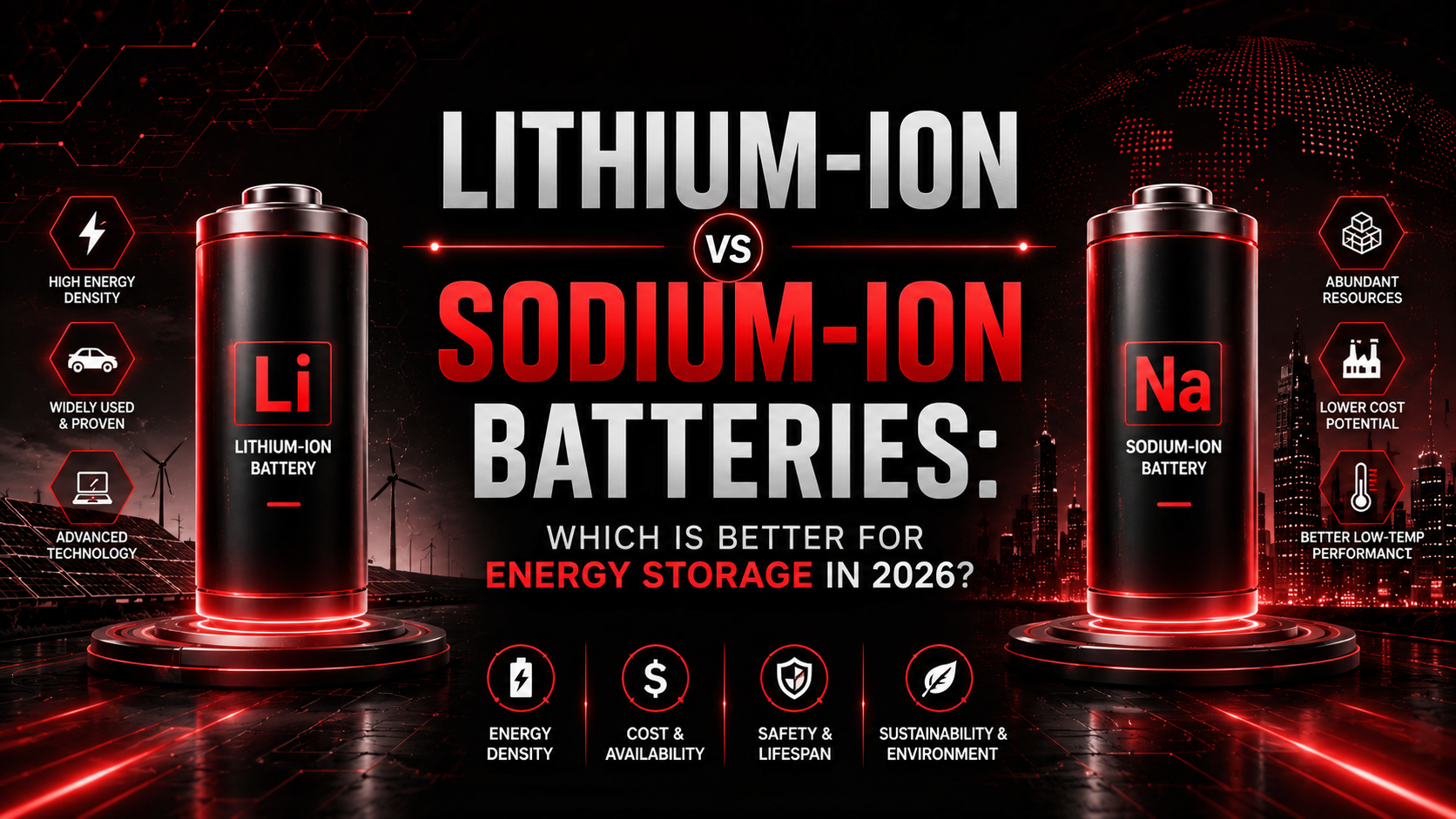
For more than a decade, the answer to "what chemistry should power my energy storage system?" was almost reflexive: lithium-ion. It won on energy density, it won on cycle life, and as manufacturing scaled, it won on price. Sodium-ion was a lab curiosity—promising on paper, perpetually five years from relevance.
That framing no longer holds. In 2026, sodium-ion crossed from pilot demonstrations into grid-connected reality, with utility-scale systems operating autonomously and battery giants moving the chemistry into mass production. The question for energy storage professionals is no longer whether sodium-ion is real, but where it fits—and where lithium-ion still deserves to win.
This is a comparison built for that decision. We'll work through the technologies dimension by dimension, ground the discussion in 2026 market data, and be specific about the trade-offs. Where our own Na+ Bricks and HPE Prime lines solve real deployment problems, we'll say so. Where lithium remains the right call, we'll say that too.
The core tension is simple: lithium has dominated for decades, so why is a lower-density chemistry suddenly competitive?
The answer is that energy density was never the only thing that mattered for stationary storage—it was just the dimension lithium happened to win decisively. A battery bolted to a concrete pad next to a solar farm does not care about weight the way an EV does. What it cares about is cost per kilowatt-hour over its lifetime, safety, resilience to temperature swings, and whether you can actually source replacement cells in year seven of a twenty-year contract.
Three forces converged to make sodium-ion's strengths suddenly relevant:
Lithium price volatility exposed supply-chain fragility.
Lithium is mined in a handful of countries, and the price swings of recent years made procurement teams acutely aware of concentration risk. Sodium, by contrast, is the sixth most abundant element on Earth and is available essentially everywhere. Sodium-ion cells are also typically cobalt-free and nickel-free, and many designs use aluminum current collectors instead of copper—removing several of the most contested materials in the battery supply chain at once.
Manufacturing matured faster than expected.
CATL launched its Naxtra sodium-ion product line in 2026 and announced large-scale deployment across energy storage and vehicle applications for 2026. HiNa connected MWh-scale sodium-ion systems to the grid in 2026, where they have since operated autonomously and without fluctuation. When the two largest battery manufacturers in the world commit production capacity, "five years away" becomes "this procurement cycle."
Safety and cold-weather regulation started favoring the chemistry.
Tightening fire-safety codes for indoor and dense installations, and the operational reality of cold-climate deployments, both play to sodium-ion's intrinsic strengths.
None of this means lithium is in retreat. Industry forecasts still expect LFP and NMC to hold the dominant share of the storage market through 2030, with sodium-ion capturing a meaningful but minority slice. What changed is that sodium-ion went from "not an option" to "an option you have to evaluate on the merits."
This is lithium's clearest and most durable advantage. Lithium-ion cells deliver roughly 150–250 Wh/kg depending on chemistry, while sodium-ion currently sits around 100–170 Wh/kg. The gap is real and it matters wherever footprint or weight is constrained.
For stationary BESS, however, the penalty is often manageable. You may need somewhat more space or a slightly larger enclosure for the same capacity—a cost on a rooftop or in a dense urban substation, but frequently a non-issue at a greenfield grid site. The practical takeaway: density determines how much sodium-ion's other advantages have to overcome, not whether they exist.
This is the dimension where expectations and reality diverge most sharply, so it's worth being precise.
In theory, sodium's abundance should make it dramatically cheaper. In 2026 practice, the absence of mature, high-volume production means the two are roughly neck-and-neck—and by some estimates, sodium-ion still costs slightly more per kWh than the cheapest LFP. One widely cited 2026 figure puts average LFP at around US$52/kWh against roughly US$59/kWh for sodium-ion, with parity not expected until the early-to-mid 2030s on a cell-cost basis.
But cell cost is not system cost, and this is where the picture shifts. Sodium-ion's robustness allows some systems to run with passive cooling rather than active thermal management. When a US grid-scale sodium-ion installation went live in Colorado in 2026, it operated without active cooling at all—eliminating an entire subsystem's worth of capital cost, parasitic load, and maintenance. Balance-of-system components routinely account for a large share of a containerized BESS's lifetime impact and cost, so removing or simplifying thermal management can change the total-cost-of-ownership math even when the cells themselves cost the same or a little more.
This is precisely the gap our Na+ Bricks platform is engineered to exploit: pairing sodium-ion's passive-cooling tolerance with a system architecture that strips out cost at the balance-of-system level rather than chasing cell-cost parity alone. The right comparison for a buyer is never sticker price per cell—it's delivered cost per usable kilowatt-hour over the system's life.
Sodium-ion's safety profile is one of its most compelling arguments for stationary use. Well-designed cells—particularly Prussian-blue-analogue and similar chemistries—have shown no thermal runaway under nail penetration, crush, and overcharge testing. Thermal-runaway risk is generally lower than NMC and broadly comparable to LFP.
For indoor installations, dense urban siting, and any application where fire code or insurance is a binding constraint, this matters enormously. It is also part of why sodium-ion is gaining traction in regions with strict safety regulation. Lithium-ion—especially NMC—remains workable but demands rigorous battery management and fire-suppression engineering to manage its higher intrinsic risk.
Here the answer depends heavily on which lithium and which sodium chemistry you compare.
General-purpose lithium-ion delivers roughly 3,000–6,000 cycles depending on chemistry, and mature LFP has a long, well-documented field record. Many current sodium-ion cells land in the 2,000–4,000 cycle range—respectable but historically a step behind. The headline, though, is that purpose-built sodium-ion storage cells are now claiming far more: certain 2026-generation grid cells advertise cycle lives above 10,000 and even 15,000 cycles while retaining 80% capacity.
The nuance worth flagging for any procurement team: a 15,000-cycle laboratory rating is not the same as a decade of validated field data. LFP's advantage in cycle life is partly that its longevity has been proven across years of real-world operation. Sodium-ion's best numbers are promising and improving fast, but the field record is still being written. Our HPE Prime line is built around LFP precisely where that proven, bankable cycle life is the deciding factor—long-duration daily cycling under warranty terms that demand a track record, not a projection.
This is an under-discussed sodium-ion advantage that can be decisive in the right geography. Lithium-ion degrades sharply in the cold—capacity losses on the order of 50% at –20°C are documented, and sub-zero charging is a persistent pain point because lithium tends to plate on the anode.
Sodium-ion's hard-carbon anode does not plate the same way, giving the battery management system more headroom before it has to lock out cold charging. Some 2026-generation cells claim usable operation and fast charging across a –40°C to 70°C window, with the bulk of capacity retained near the bottom of that range. For pole-mounted off-grid systems, northern-climate solar, and remote installations, that cold-charge headroom changes the engineering math.
These two pull in opposite directions, and a clear-eyed buyer should weigh both.
On resilience, sodium-ion is structurally advantaged: abundant raw materials, no lithium or cobalt dependency, geographically distributed inputs, and even chemistry-specific perks like 0V transport tolerance that simplifies shipping logistics and hazmat handling.
On maturity, lithium-ion is far ahead. LFP has multiple qualified suppliers on every continent, standardized formats, and established recycling pathways. Sodium-ion's supply chain in 2026 is still thin, formats are not yet standardized, and a buyer signing a long municipal contract should ask a pointed question: will I be able to source an exact replacement cell in year seven? For lithium that answer is settled; for sodium-ion it is improving but not yet guaranteed.
If you stepped away from this topic in 2023, the milestones of 2026 reframe it:
The trajectory from here: most analysts see sodium-ion's cost on a faster downward slope than lithium's, even though it starts from rough parity, with some projecting US$40–50/kWh by 2027–2028 as volume scales. Sodium-ion is widely expected to settle into a meaningful minority share of stationary storage by 2030—largest precisely where its strengths concentrate—while LFP and NMC retain the majority. In short: lithium is the safe choice for today's needs; sodium-ion is being proven out for tomorrow's, especially where cost-at-scale, safety, and cold tolerance outrank density.
Strip away the hype and the decision comes down to matching chemistry to the constraint that actually binds your project.
Choose lithium-ion (and look at HPE Prime) when:
Consider a hybrid or tiered approach when your portfolio spans use cases that no single chemistry serves optimally. A facility might deploy lithium-ion where density and proven longevity are non-negotiable, while standing up sodium-ion for cost-sensitive, safety-critical, or cold-climate capacity. Tiering by duty cycle—lithium for high-density, fast-response duty and sodium-ion for robust bulk storage—lets you optimize cost and resilience together instead of forcing one chemistry to do everything. Our team works through exactly these mixed-chemistry deployment scenarios when the right answer is "both, allocated deliberately."
Lithium-ion has not been dethroned, and anyone telling you sodium-ion is a wholesale replacement is overselling. What 2026 established is that the two chemistries now occupy a shared decision space, and the right choice is genuinely application-dependent for the first time.
Lithium-ion remains the benchmark for energy density and proven, bankable performance. Sodium-ion has earned a seat at the table on cost resilience, safety, cold-weather operation, and supply-chain security—and its trajectory is steeper. The professionals who win over the next few years will be the ones who stop asking "which is better?" in the abstract and start asking "better for this constraint, at this site, under this contract?"
That is the question we built Na+ Bricks and HPE Prime to answer from both sides. If you're weighing a specific deployment, talk to our engineering team—we'd rather help you pick the right chemistry than sell you the wrong one.
1. Are sodium-ion batteries cheaper than lithium-ion in 2025?
Not yet on a per-cell basis. Despite sodium's abundance, limited high-volume production means sodium-ion costs roughly the same as—or slightly more than—the cheapest LFP, with one 2025 estimate putting LFP near $52/kWh against ~$59/kWh for sodium-ion. The savings show up at the system level: sodium-ion's robustness can eliminate active cooling, cutting balance-of-system cost. Cell-cost parity isn't expected until the early-to-mid 2030s.
2. Which lasts longer, sodium-ion or lithium-ion batteries?
It depends on the chemistry. General-purpose lithium-ion delivers ~3,000–6,000 cycles, and LFP has a long, proven field record. Purpose-built sodium-ion grid cells now claim 10,000–15,000 cycles at 80% retention—on paper, longer. The caveat: those are ratings, not decades of validated field data, which is still LFP's edge.
3. Are sodium-ion batteries safer than lithium-ion?
Generally, yes, for stationary use. Well-designed sodium-ion cells show no thermal runaway under nail-penetration, crush, and overcharge testing, with risk lower than NMC and comparable to LFP. This makes them attractive for indoor, dense, or fire-code-constrained installations.
4. Do sodium-ion batteries perform better in cold weather?
Often, yes. Lithium-ion can lose ~50% capacity at –20°C and struggles with sub-zero charging. Sodium-ion's hard-carbon anode doesn't plate the same way, giving more cold-charge headroom—some 2025 cells claim usable operation across –40°C to 70°C.
5. When should I choose lithium-ion over sodium-ion for energy storage?
Choose lithium-ion when energy density or footprint is constrained, when you need a proven, bankable cycle-life and warranty record, when you require multiple qualified suppliers today, or when your timeline can't wait for sodium-ion's supply chain to mature.
We use cookies to enhance your browsing experience, analyze site traffic, and personalize content. By continuing to use our site, you consent to our use of cookies. Learn more