07.07.2026
By Trydan Tech Team

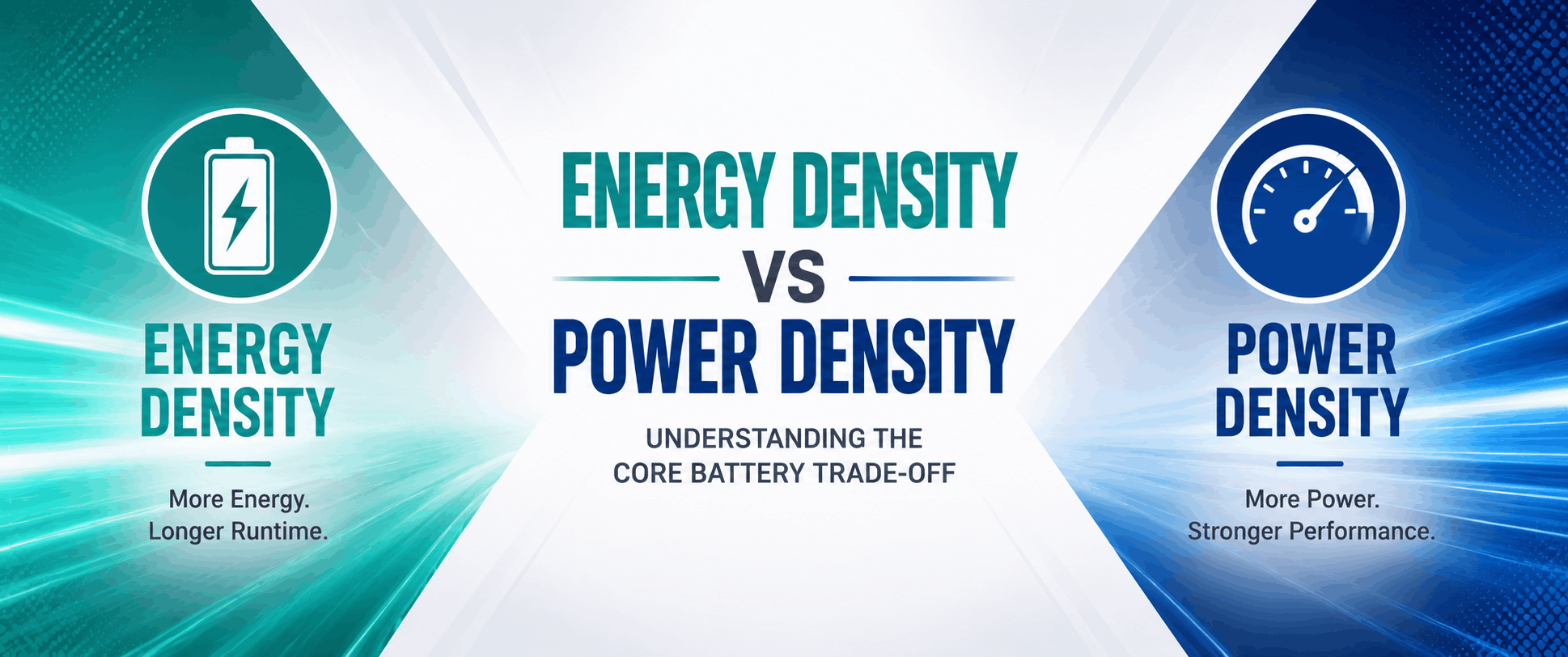
Every OEM engineer who has ever tried to spec a battery cell for a new platform runs into the same wall eventually: the datasheet that promises outstanding runtime cannot also promise outstanding burst performance, and the datasheet built for aggressive discharge rarely wins on weight or range. This is not a marketing gap or an engineering oversight. It is a physical trade-off baked into how a lithium-ion cell is built, and understanding it is the single most useful piece of knowledge an engineer can bring to a pack design review.
Energy density and power density are often used loosely, sometimes interchangeably, in early-stage sourcing conversations. That is a mistake. They describe two different jobs a cell can do, and a cell architecture optimized for one job is, almost by definition, compromised at the other. This explainer breaks down what each term actually means at the electrochemical level, why the trade-off exists, and how it plays out in two real product lines built for opposite ends of the spectrum: the HV Series NMC pouch cell, engineered for maximum energy density, and the HPE Series LFP prismatic cell, engineered for sustained power density and cycle durability. Both are built with the same underlying goal, delivering a cell that matches the mission profile of the application it goes into, but they arrive at that goal from opposite design philosophies.
Energy density describes how much energy a cell can store relative to its size or weight. It is expressed two ways:
• Gravimetric energy density (Wh/kg): energy stored per unit of mass. This is the number that matters most for anything that flies, walks, or gets carried, since every gram of cell mass is a gram the platform has to lift or the operator has to carry.
• Volumetric energy density (Wh/L): energy stored per unit of volume. This matters most when the enclosure, not the payload budget, is the binding constraint, such as a pack that has to fit inside a fixed telecom cabinet footprint.
A cell with high energy density lets an engineer either shrink the pack for a given runtime target or extend runtime for a given pack size. This is the metric that drone OEMs obsess over, because flight time is close to a linear function of usable Wh per kilogram once airframe and motor efficiency are fixed. It is also the metric that matters for portable medical devices, handheld power tools, and any consumer or industrial product where the battery is a meaningful fraction of total device weight.
Energy density is largely a function of the active material chemistry and the electrode architecture. Nickel-rich NMC (nickel manganese cobalt oxide) cathodes pack more lithium-ion capacity per gram than iron-based chemistries like LFP (lithium iron phosphate), which is why energy-density leadership almost always traces back to a nickel-rich cathode paired with a graphite or silicon-graphite anode. Cell format matters too. A pouch cell, built from laminated foil rather than a rigid metal can, eliminates the mass and volume overhead of a can wall, which is one reason pouch construction shows up so often in energy-density-first designs.
Power density describes how quickly a cell can discharge (and often charge) its stored energy, again expressed gravimetrically (W/kg) or volumetrically (W/L). Where energy density asks “how much fuel is in the tank,” power density asks “how fast can the tank empty without the engine stalling.”
Power density is governed by internal resistance. Lower internal resistance means less energy lost to heat during high-current events and a flatter voltage sag under load, both of which translate into more usable power at the terminals. Internal resistance itself is shaped by several design levers:
• Electrode thickness. Thin electrodes shorten the lithium-ion diffusion path between the electrolyte and the active material, reducing polarization at high C-rates. Thick electrodes pack in more active material (helping energy density) but slow down ion transport (hurting power density).
• Particle size and coating. Smaller, well-coated active material particles offer more surface area for ion exchange, supporting faster charge and discharge.
• Separator design and electrolyte formulation. Lower-resistance separators and electrolytes optimized for ionic conductivity reduce internal impedance, directly raising achievable C-rates.
• Current collector and tab design. Wider tabs and lower-resistance current collector foils reduce the ohmic bottleneck at the point where current actually exits the cell, which is especially important in high-discharge applications like drones and power tools.
• Chemistry. LFP's olivine crystal structure is inherently more thermally and structurally stable at high current draw than layered NMC oxides, which is part of why LFP chemistries tend to sustain high continuous discharge rates over thousands of cycles without the same degree of structural fatigue.
A cell engineered for power density accepts a lower Wh/kg ceiling in exchange for sustained high-current capability, flatter thermal behavior under load, and, in the case of LFP, a longer cycle life at deep discharge. This is exactly the profile needed for telecom backup power, grid-tied battery energy storage systems (BESS), and industrial equipment that needs to deliver strong, repeatable current for years without significant capacity fade.
The tension between energy density and power density is not a matter of insufficient engineering effort. It is a direct consequence of the same design levers pulling in opposite directions.
Consider electrode thickness again. Thick electrodes with high active material loading store more energy per unit weight and volume, because a greater share of the electrode stack is doing electrochemical work rather than sitting idle as inert current collector or separator. But that same thickness means lithium ions travel a longer path to reach the deeper layers of the electrode during a high-current pulse, and diffusion cannot outrun demand indefinitely. Push the discharge rate too high on a thick, energy-dense electrode and you get voltage sag, localized heating, and accelerated degradation.
Now consider chemistry. Nickel-rich NMC delivers a higher specific capacity than LFP, which is the foundation of its energy density advantage, but nickel-rich layered oxides are more prone to thermal instability and structural degradation under sustained high-rate cycling than the more thermally robust olivine structure in LFP. LFP trades away specific capacity for structural and thermal stability, which is precisely what sustained power density and long cycle life require.
Format plays a role too. Pouch construction minimizes dead weight, supporting energy density, but a prismatic can format offers more mechanical rigidity and more consistent internal pressure distribution across large-format cells, both of which support the stable, repeatable high-current cycling that power-density-first applications demand over a multi-year service life.
None of this means an engineer is stuck choosing blindly. It means cell selection has to start with an honest characterization of the mission profile: is the priority minimizing weight and maximizing runtime, or is it sustaining high, repeatable current over years of duty cycles? That single question usually resolves which end of the spectrum to design around.
The HV Series NMC pouch cell line is built for applications where every gram matters and where flight time, range, or portability is the primary performance metric. The core HV Series cell is a 10Ah pouch lithium cell built on a nickel-rich NMC cathode paired with the proprietary DAMS cathode material architecture, delivering 300 Wh/kg at the cell level, a figure that sits well above what LFP-based chemistries can achieve.
This is what makes the HV Series a genuine high energy density pouch cell: the pairing of a nickel-rich cathode, a thin, low-inert-mass pouch format, and an electrode architecture tuned to maximize active material loading per gram of total cell weight. Nominal voltage sits at 3.9V, and cycler validation data (4C charge, 15C continuous discharge, 25C pulse discharge) confirms the cell can still deliver meaningful high-rate performance despite being optimized primarily around energy density rather than sustained power density. This dual capability, strong Wh/kg alongside respectable discharge headroom, is exactly what makes it a credible lithium pouch cell for drones, where both flight time and motor burst demand during maneuvers have to be satisfied by the same cell.
Pack configurations for the HV Series, including 6S1P and 12S2P architectures, are built around this same logic: keep the pack as light as possible for a given energy budget, since drone airframes, portable robotics, and handheld equipment all pay a direct performance penalty for every gram of pack mass. The lightweight pouch battery cell architecture underpinning the HV Series line extends this weight discipline down to the cell level itself, with the laminated foil pouch format eliminating the metal can overhead that would otherwise eat into the payload budget of a UAV or the runtime budget of a handheld tool.
For OEMs building drones, portable robotics, or any platform where flight time or carry time is a competitive differentiator, the HV Series represents the energy-density end of the spectrum: maximum Wh per kilogram, competitive Wh per liter, and enough rate capability to handle the transient current spikes that come with aggressive flight maneuvers or tool torque demands, without carrying the mass penalty of a chemistry or format built primarily around sustained high-current cycling.
The HPE Prime Series takes the opposite design path. Built on an LFP prismatic architecture at 102Ah, the HPE Prime cell delivers 163 Wh/kg, a meaningfully lower energy density than the HV Series, but that lower figure is the direct trade for what LFP and prismatic construction offer instead: sustained 2C continuous and 4C pulse discharge, over 6,000 cycles to at least 70% state of health, 89.9% capacity retention at minus 20 degrees Celsius, and an internal resistance as low as 0.34 milliohm DCIR.
Those numbers describe a cell built to run hard, run cold, and run for years without meaningful capacity fade, exactly the profile telecom backup power, solar-plus-storage, and grid-tied BESS installations need. A telecom tower backup system or a BESS container does not care about shaving grams the way a drone airframe does. It cares about delivering rated power reliably through thousands of charge-discharge cycles, holding up in cold climates, and minimizing internal resistance so that less energy is wasted as heat during the frequent partial-cycling these applications experience. The rigid prismatic can format supports this mission by holding consistent internal pressure and dimensional stability across a multi-year service life in a way that a pouch format, optimized for minimum mass, is not built to do at this scale.
Where the HV Series is the answer to “how do I maximize runtime per gram,” the HPE Series is the answer to “how do I guarantee rated power output, cycle after cycle, for a decade of unattended field service.”
The HV Series NMC pouch cell is built around energy density as its primary design goal, while the HPE Prime Series LFP prismatic cell is built around power density and cycle life. The HV Series uses a pouch cell format, whereas the HPE Prime Series uses a prismatic format. In terms of capacity, the HV Series is a 10Ah cell, while the HPE Prime Series is a 102Ah cell. On gravimetric energy density, the HV Series delivers 300 Wh/kg, considerably higher than the HPE Prime Series' 163 Wh/kg. Nominal voltage sits at 3.9V for the HV Series, compared to the LFP-class nominal voltage of roughly 3.2V for the HPE Prime Series.
Where the two diverge most sharply is discharge behavior and longevity. The HV Series supports 15C continuous discharge and 25C pulse discharge, prioritizing burst performance for weight-sensitive, mobile applications. The HPE Prime Series, by contrast, supports a more modest 2C continuous discharge and 4C pulse discharge, but sustains that output over 6,000-plus cycles to 70-80% state of health, whereas the HV Series is optimized for high-rate cycling rather than a headline cycle count. Cold-weather performance is not the primary design target for the HV Series, while the HPE Prime Series retains 89.9% of its capacity at minus 20 degrees Celsius, making it far better suited to outdoor, cold-climate deployment. Internal resistance follows a similar pattern: the HV Series is optimized for high-rate response, while the HPE Prime Series achieves a DCIR as low as 0.34 milliohm, supporting long-term efficiency under repeated cycling.
These differences translate directly into best-fit applications. The HV Series is best suited to drones, portable robotics, and power tools, where minimizing weight and handling burst current matter most. The HPE Prime Series is best suited to telecom, solar, battery energy storage systems (BESS), and grid backup applications, where sustained power delivery, cold-weather reliability, and multi-year cycle life are the deciding factors.
Drones and UAVs. Flight time is directly proportional to usable Wh per kilogram, and every additional gram of battery mass is a gram not available for payload, sensors, or airframe reinforcement. This is the textbook case for maximizing gravimetric energy density, and it is also why so many UAV programs specifically look for a lithium pouch cell for drones rather than a cylindrical or prismatic alternative: pouch format strips out unnecessary can mass, and NMC chemistry delivers the specific energy needed to hit meaningful flight-time targets. A 10Ah pouch lithium cell in a 6S1P configuration, for example, gives smaller UAV platforms a compact, weight-efficient building block that scales cleanly to larger 12S2P packs as payload and endurance requirements grow. Burst current during takeoff, hover correction, and aggressive maneuvers still matters, which is why the HV Series' 25C pulse rating exists alongside its energy-density-first design.
Portable power tools and handheld equipment. Similar logic applies. Operators feel every gram over an eight-hour shift, and tool torque demands short, high-current pulses rather than sustained multi-hour discharge. A lightweight pouch battery cell with strong pulse discharge headroom, like the HV Series, matches this profile closely.
Telecom backup power. Towers need to deliver rated backup current reliably, in all weather, for years, with minimal maintenance visits. Cold-climate performance and DCIR matter enormously here, since a tower in a cold region that cannot hold capacity at low temperature is a tower that goes dark during exactly the storm conditions when backup power is needed most. This is squarely HPE Series territory.
Solar and grid-tied BESS. These systems cycle daily, sometimes multiple times per day, for a projected service life measured in decades. Cycle life to 70% state of health, low internal resistance to minimize round-trip energy loss, and dimensional stability under repeated thermal cycling are the metrics that determine total cost of ownership over the life of the asset. LFP prismatic architecture, as in the HPE Prime line, is purpose-built for exactly this duty cycle.
Sodium-ion for telecom and stationary storage. It is worth noting that the energy density vs power density trade-off is not exclusive to NMC and LFP. Sodium-ion chemistry, represented in the Na+ Brick line, occupies its own point on the spectrum, trading some gravimetric energy density for cost advantages, cold-temperature efficiency, and cycle life exceeding 10,000 cycles at 70% depth of discharge, making it a compelling option for stationary telecom and grid applications where raw material cost and long-term cycling matter more than gravimetric energy density.
The cell-level trade-off cascades directly into pack design decisions. A pack built around energy-density-first cells, like HV Series 6S1P or 12S2P configurations, is engineered around minimizing structural overhead: thinner enclosures, lighter interconnects, and BMS architectures tuned for high-rate transient protection rather than long-duration thermal management. A pack built around power-density-first cells, like HPE Prime 48V configurations for telecom towers, is engineered around thermal consistency, mechanical robustness for outdoor deployment, and BMS logic tuned for deep, repeated cycling over a multi-year field life rather than transient burst protection.
This distinction matters when engineers evaluate total cost of ownership. A telecom operator comparing pack options for a tower deployment needs to weigh CAPEX per pack against cycle life, cold-weather derating, and OPEX from truck rolls for maintenance or replacement, not just headline Wh/kg. A drone OEM evaluating the same decision needs to weigh flight-time-per-dollar against payload capacity lost to excess pack weight, not cycle life over a decade the airframe will likely be retired well before reaching. Applying HV Series logic to a telecom deployment, or HPE Series logic to a UAV program, produces a mismatched, underperforming system even if every individual cell spec looks impressive on paper.
Datasheet numbers are a starting point, not a substitute for validation. When evaluating a cell against a specific mission profile, engineers should request or independently verify:
• Discharge curve behavior at the actual C-rate the application will see, not just the rated maximum. A cell rated for 15C continuous discharge should be evaluated at the specific current draw the application actually produces, since voltage sag behavior at 5C looks very different from behavior at the rated ceiling.
• Cycle life data at the actual depth of discharge the application will use. Cycle life figures quoted at 80% DoD do not directly translate to performance at 100% DoD, and vice versa.
• Temperature-dependent performance data, especially for applications with outdoor or uncontrolled thermal exposure. A cell's room-temperature DCIR is not representative of its behavior at minus 10 or minus 20 degrees Celsius.
• Round-trip efficiency at the pack level, not just cell-level specific energy, since interconnect resistance, BMS overhead, and thermal management losses all subtract from the usable energy an application actually sees.
• Safety certification data appropriate to the deployment region and application class, including relevant abuse testing (short circuit, overcharge, crush, thermal runaway propagation) for the specific cell format and chemistry in question.
Neware cycler test data, properly logged with temperature tracking alongside voltage and current, remains the gold standard for validating whether a cell's real-world discharge behavior matches its datasheet claims, and any serious sourcing decision should include a request for this level of test transparency before a design is locked.
For US-based OEMs, particularly those in defense, telecom infrastructure, and other sectors where supply chain resilience and domestic content requirements carry real regulatory and commercial weight, working with a pouch cell manufacturer USA option is increasingly a design input, not just a procurement preference. Supply chain disruption risk, IRA and FEOC domestic content considerations for grid and BESS-adjacent programs, and simple logistics lead time all favor a manufacturing relationship with US-based commercial operations and support, even when contract manufacturing scale is sourced internationally.
Working with a pouch cell manufacturer USA also shortens the iteration loop for custom pack configurations, safety testing coordination, and application-specific engineering support, since technical teams can work in the same time zone and business context as the OEM's own engineering group, rather than routing every design question through an extended overseas communication chain. For programs where certification testing, safety validation, and rapid design iteration are on the critical path, this proximity has real schedule value that does not show up on a cell datasheet but shows up directly in program timelines.
When facing a cell selection decision, engineers can shortcut a lot of back-and-forth by starting with three questions:
1. Is mass or volume the binding constraint, or is duty cycle and service life the binding constraint? If the platform is mobile and weight-sensitive, lean toward energy-density-first architectures like the HV Series. If the platform is stationary and cycle-heavy, lean toward power-density-first architectures like the HPE Series.
2. What does the actual current draw profile look like, not the theoretical maximum? A platform with brief high-current bursts against a mostly moderate baseline load has different needs than one running continuous high current for hours.
3. What is the expected service life and environmental exposure? A two-year consumer product lifecycle tolerates different degradation curves than a fifteen-year grid asset, and a climate-controlled indoor deployment tolerates different cold-weather derating than an outdoor tower site.
Answering these honestly, before comparing datasheets, prevents the common mistake of chasing the highest headline Wh/kg or the highest headline C-rate without checking whether that number actually maps to the application's real mission profile. Energy density and power density are not competing marketing claims to be maximized simultaneously. They are two different engineering answers to two different questions, and the right cell is the one whose answer matches the question the application is actually asking.
Is a higher Wh/kg cell always the better choice? Not necessarily. A higher Wh/kg number is only an advantage if the application's limiting factor is actually weight or volume. For a stationary telecom cabinet with a fixed footprint and a multi-year duty cycle, cycle life, cold-weather retention, and internal resistance matter more to total cost of ownership than shaving grams off a cell that will never be carried or flown. Engineers should weigh Wh/kg against the actual constraint the platform faces, not treat it as a universal scoring metric.
Can a single chemistry ever deliver both high energy density and high power density? Cell design can push the boundary in both directions simultaneously through better materials science, thinner separators, improved current collector design, and more conductive electrolyte formulations, but there is no free lunch. Every improvement that raises specific energy tends to trade against rate capability, and vice versa, because both properties compete for the same electrode volume and the same ion transport pathways. The practical answer is to select the cell whose balance point best matches the mission profile rather than searching for a cell that dominates on every axis.
How does cell format (pouch vs prismatic vs cylindrical) interact with the energy vs power trade-off? Format is a second, largely independent lever layered on top of chemistry. Pouch format minimizes dead weight and supports energy density regardless of chemistry, which is why pouch construction is common in energy-density-first NMC designs. Prismatic format offers more mechanical rigidity and more even internal pressure distribution across large-format cells, which supports the stable, repeatable high-current cycling that power-density-first LFP designs need over a multi-year service life. Cylindrical format sits in between, offering strong mechanical robustness and manufacturing consistency at the cost of some volumetric efficiency compared to pouch.
What should an OEM ask a manufacturer before committing to a cell for a new platform? At minimum, request Neware cycler discharge curves at the actual current draw the platform will produce, cycle life data at the actual depth of discharge planned for the application, temperature-dependent performance data across the expected operating range, and relevant abuse and safety certification data for the target deployment region. A manufacturer willing to share this level of test transparency, rather than just headline datasheet numbers, is signaling confidence in how the cell will actually perform once it leaves the lab.
Does domestic sourcing actually change cell performance, or is it purely a supply chain consideration? Domestic sourcing does not change the electrochemistry inside the cell, but it directly affects how quickly design issues get resolved, how fast custom pack configurations move from concept to validated hardware, and how exposed a program is to freight delays, tariff shifts, or export restrictions. For programs on tight qualification timelines, or subject to domestic content requirements tied to grid, defense, or infrastructure funding, working with a US-based commercial and engineering team can shorten the path from cell selection to fielded hardware even when the underlying chemistry and format are otherwise comparable to overseas alternatives.
The energy density vs power density trade-off is not a limitation to be engineered away. It is a fundamental property of how lithium-ion cells store and deliver charge, rooted in electrode thickness, particle architecture, electrolyte chemistry, and cell format. The HV Series NMC pouch cell and the HPE Prime LFP prismatic cell represent two well-defined answers to two different engineering problems: one optimized as a high energy density pouch cell for weight-constrained, mobile applications like UAVs and portable equipment, the other optimized for sustained power delivery and multi-year cycle life in stationary telecom, solar, and grid-storage deployments. Understanding which end of the spectrum a given application actually needs, and validating that understanding against real discharge and cycle data rather than headline datasheet numbers, is the difference between a battery selection that quietly meets its mission for years and one that becomes the bottleneck the whole platform gets blamed for.
We use cookies to enhance your browsing experience, analyze site traffic, and personalize content. By continuing to use our site, you consent to our use of cookies. Learn more