06.01.2026
By Marketing Team

Why Sodium-Ion Batteries Are Emerging as the Next Big Alternative to Lithium

Why Sodium-Ion Batteries Are Emerging as the Next Big Alternative to Lithium

A New Era in Rechargeable Energy Systems 

Lithium-ion batteries transformed the world. In the 1990s and early 2000s, consumer electronics rapidly shifted from nickel-based chemistries to lithium-ion because of its superior energy density, lightweight structure, and rechargeable performance. As smartphones, laptops, and later electric vehicles scaled globally, lithium-ion became the default choice for almost every high-growth battery application. 

The key advantage was simple: more energy stored in less space and less weight. This allowed products to become smaller, portable, and more powerful at the same time. 

The Core Problems With Lithium 

Lithium-ion dominance also revealed limitations that become more visible as demand grows: 

  • Limited raw material availability – Lithium is geographically concentrated. Mining and refining cannot scale at the same pace as global battery demand. 
  • Cost volatility – The price of lithium and lithium-based cathode materials fluctuates heavily depending on supply bottlenecks, geopolitical dependencies, and refinery capacity. 
  • Cold temperature performance challenges – Graphite-based lithium cells suffer reduced ion mobility at sub-zero temperatures, impacting power delivery and effective capacity. 
  • Safety sensitivity under abuse conditions – High-energy lithium chemistries are prone to thermal runaway when internal short circuits, over-charge, or mechanical damage occur. 
  • Long charging times in certain chemistries – Graphite anodes limit fast-charging acceptance unless silicon or specialized designs are introduced, which further increases cost. 
  • Environmental and processing complexity – Extraction, cathode refining, and electrolyte formulations require high purity standards, increasing manufacturing overhead. 

These issues created the need for chemistries that rely on more abundant and stable materials while delivering competitive performance. 

Understanding Sodium-Ion Batteries 

Sodium-ion batteries operate on the same fundamental rocking-chair intercalation mechanism as lithium-ion. Instead of lithium ions (Li⁺), sodium ions (Na⁺) shuttle between the cathode and anode during charge and discharge. 

A more technical breakdown: 

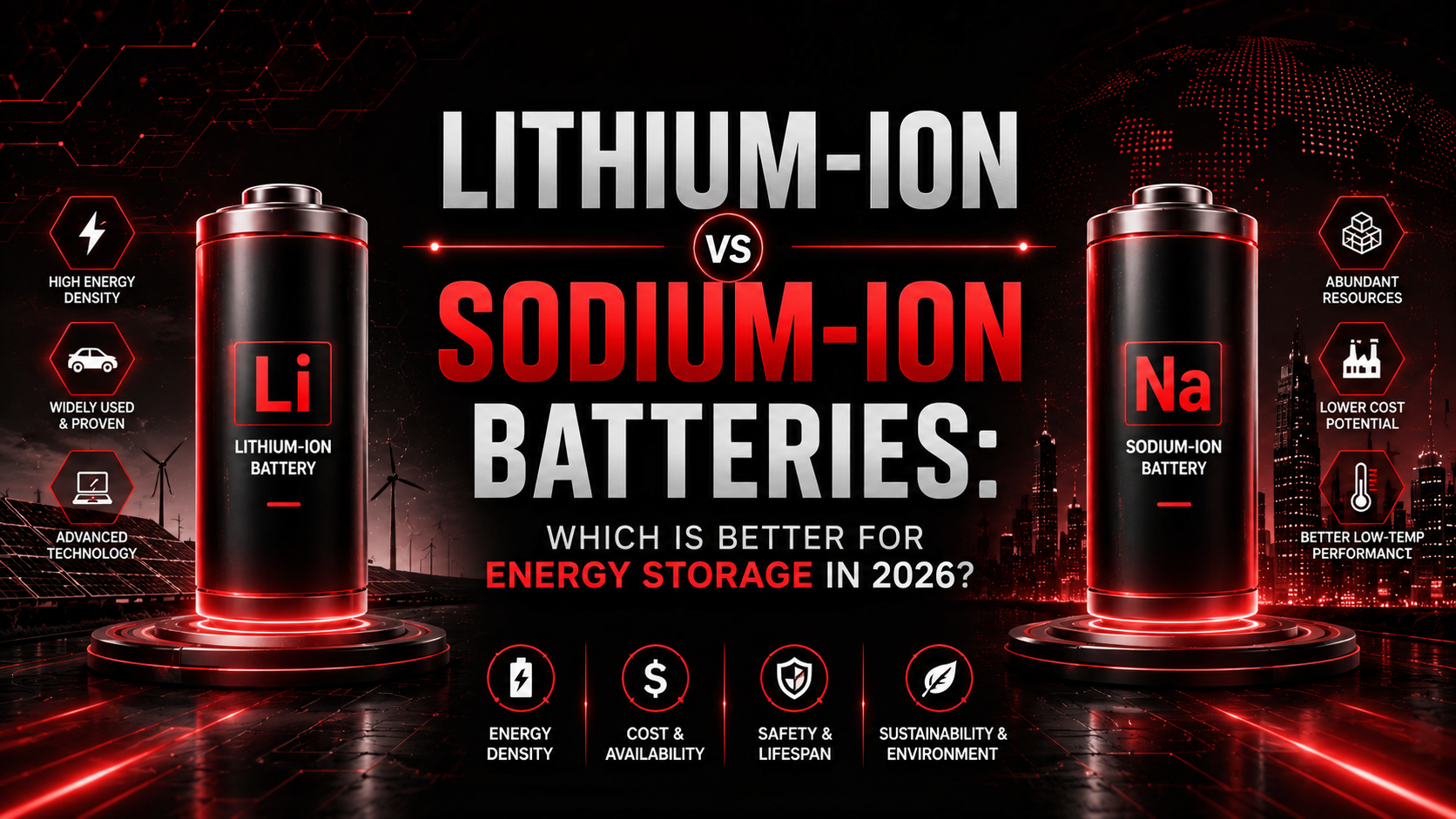
  • Ionic radius – Sodium ions are larger than lithium ions (Na⁺ ~1.02 Å vs Li⁺ ~0.76 Å). This impacts intercalation behavior and diffusion kinetics. 
  • Anode behavior – Graphite does not form a stable Na-intercalated compound, so sodium cells commonly use hard carbon or non-graphitic intercalation hosts. 
  • Cathode structure – Most sodium cathodes adopt layered oxides (NaxMO₂), Prussian-blue analogues (Na₂Fe[Fe(CN)₆]), or polyanionic frameworks such as Na₃V₂(PO₄)₃. These structures accommodate sodium’s size while enabling reversible cycling. 
  • Standard potential difference – Sodium’s electrochemical potential is slightly higher than lithium (-2.71 V vs SHE for Na⁺/Na vs -3.04 V for Li⁺/Li), resulting in lower theoretical cell voltage but improved stability. 
  • Manufacturing compatibility – Sodium cells can be processed using existing lithium-ion electrode coating, electrolyte filling, and formation infrastructure with adjustments to anode and cathode formulation. 

Although energy density is currently lower than advanced lithium chemistries, sodium’s performance in other key areas makes it a compelling alternative. 

Key Benefits of Sodium-Ion Batteries 

  • Raw material abundance – Sodium is widely available from seawater and mineral salts, reducing dependency on constrained mining regions. 
  • Lower and more stable cost – Cathodes often use iron-based or manganese-based compounds that are inexpensive and do not require cobalt or nickel in many designs. 
  • Improved low-temperature power performance – Hard carbon structures and sodium diffusion kinetics show better charge-transfer stability in cold environments compared to graphite-dominant lithium cells. 
  • Higher thermal stability and safer abuse tolerance – Sodium electrolytes and cathode hosts demonstrate lower thermal runaway severity due to weaker exothermic decomposition pathways. 
  • Long lifecycle capability – Commercial sodium cells are already demonstrating 10,000–12,000+ cycle designs in lab-to-pilot stages using optimized hard carbon and Prussian-blue or polyanionic cathodes. 
  • Sustainability advantage – Less copper current collector use in some designs, simpler refining chains, and no lithium mining significantly reduce environmental processing overhead. 

Industries That Benefit Most 

Sodium-ion batteries are especially valuable in sectors where safety, cost, longevity, and uptime outweigh absolute maximum energy density: 

ESS energy storage: Reliable cold weather uptime, stable cost, and reduced thermal risk improve large scale stationary backup modules and remote deployments. 

Grid storage and renewable buffering: Long cycle life enables economic 10+ year deployments without rapid capacity fade, reducing battery replacement frequency. 

2 wheeler and 3 wheeler EVs: Cost reduction without compromising safety makes sodium suitable for mobility platforms in price sensitive markets. 

Vehicle starters: High current cranking with lower voltage sag improves cold ignition reliability, especially in vehicles with frequent stop start duty cycles. 

TCO Comparison: Sodium vs. Lithium 

Assume 1 full charge-discharge cycle per day: 

  • LFP lithium-ion cycle life = 6000 cycles 
  • 6000 ÷ 365 = 16.43 years theoretical 
  • Sodium-ion cycle life = 12,000 cycles 
  • 12,000 ÷ 365 = 32.87 years theoretical 

Real-world battery life is lower due to partial cycling, calendar aging, temperature, and depth-of-discharge effects. If we assume 70% usable life realization for both chemistries: 

  • LFP realistic years ≈ 16.43 × 0.70 = 11.50 years 
  • Sodium realistic years ≈ 32.87 × 0.70 = 23.01 years 

Cycle life difference translated into realistic years: 

  • 23.01 − 11.50 = 11.51 additional years of service life with sodium-ion 

Even under conservative assumptions, sodium delivers more than double the usable lifespan of standard LFP-based deployments and significantly reduces long-term replacement cost for infrastructure energy storage. 

Conclusion: Why Sodium-Ion Batteries Are Emerging as the Next Big Alternative to Lithium 

Sodium-ion batteries are no longer theoretical. They represent a shift toward safer, longer-lasting, cost-resilient energy storage built on abundant materials. While lithium-ion unlocked portability and high energy electronics, sodium-ion is unlocking scalability and stability for the next era of storage-heavy infrastructure. 

Trydan Tech is actively contributing to this transition by advancing next-generation sodium-ion cells and ESS modules engineered for real-world operating conditions where uptime, lifecycle, safety, and cost stability matter most. We are using our patented sodium-ion technology to build the next generation of energy storage solutions based on abundant materials, long service life, and supply-chain resilience. Our sodium-ion platform focuses on performance that competes in infrastructure and mobility applications, reducing dependency on constrained lithium resources while enabling scalable, safer, and economically durable battery deployments. 

Similar articles

Adapting Power Systems for the Modern Telecom Network

16.10.2025

Adapting Power Systems for the Modern Telecom Network

Telecommunication networks depend on continuous and stable power to keep cell towers, base stations, and edge nodes operating. Eve...

The Changing Role of UPS Systems in Modern Data Centers

15.10.2025

The Changing Role of UPS Systems in Modern Data Centers

A Uninterruptible Power Supply (UPS) is a system that provides backup power when the main electrical supply fails or fluctuates.

Traditional Lithium-Ion Cells vs. Tabless Cells: A Leap in Battery Innovation

25.09.2025

Traditional Lithium-Ion Cells vs. Tabless Cells: A Leap in Battery Innovation

Lithium-ion batteries have powered the modern age, from smartphones to electric vehicles (EVs). Yet, even the most advanced traditional cells face challenges such as heat generation, limited power delivery, and efficiency loss under high demand.

We use cookies to enhance your browsing experience, analyze site traffic, and personalize content. By continuing to use our site, you consent to our use of cookies. Learn more
Hello! 👋

Have questions about our products? Chat with us on WhatsApp!

Click the button below to start a conversation with our team. We're here to help you with any inquiries about our energy storage solutions!

Available Monday - Saturday, 9 AM - 6 PM IST