
More Usable Energy.
Long Life.
Lower Total Cost of Ownership.
Trydan Tech's HPE Prime Series 102 Ah LFP prismatic cell is engineered to deliver more usable energy, longer cycle life, and higher discharge capability in a compact large-format design. With 90% DoD, low DCIR, and strong cold-temperature performance, it provides more real energy per cell, fewer cells per pack, and lower system cost. Built for demanding stationary and backup applications, the HPE Prime Series combines high reliability, long service life, and strong power capability across telecom, residential energy storage, and battery pack manufacturing.
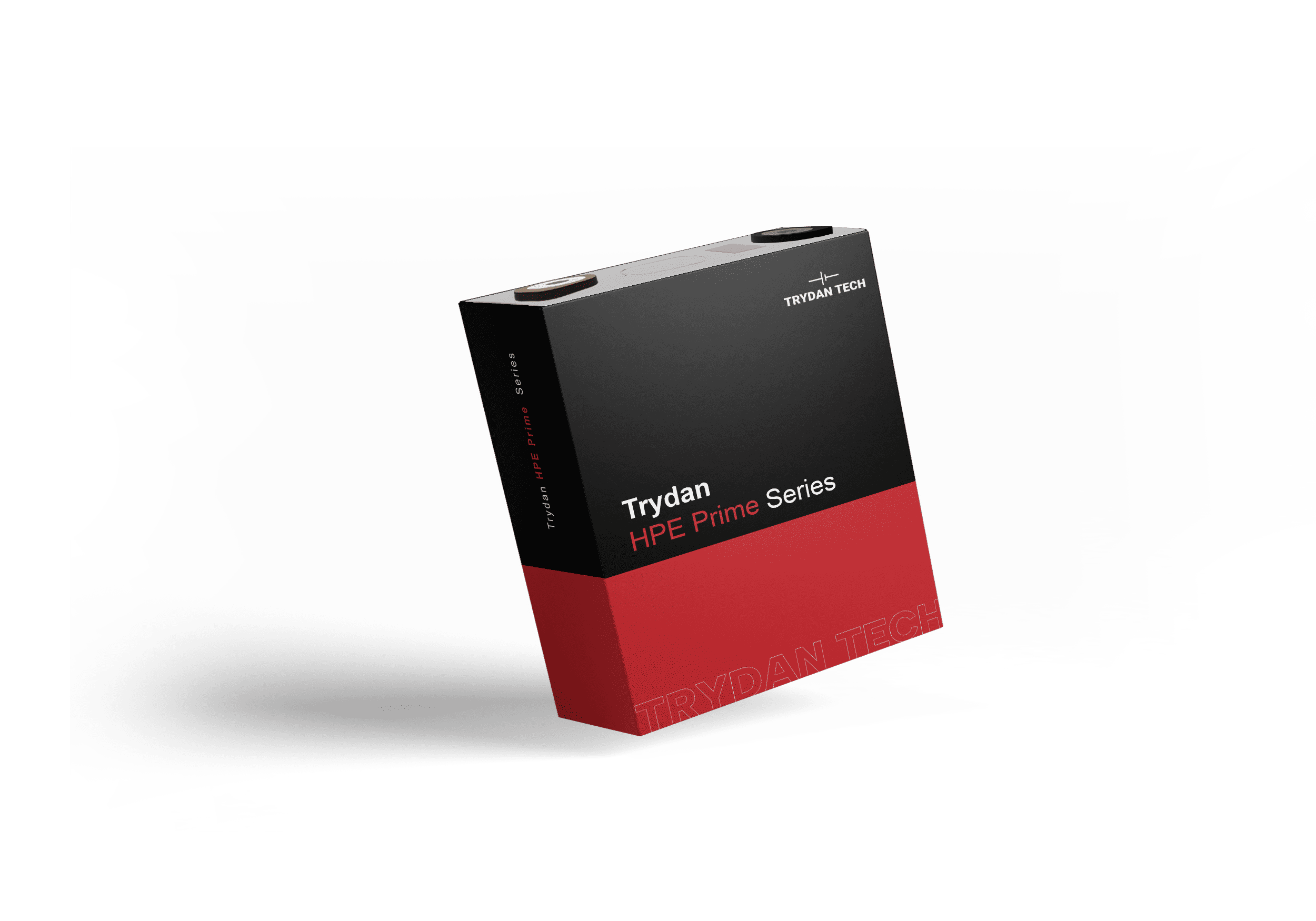
Large-format performance with high reliability, long service life, and strong power capability across stationary and backup systems.
Engineered for more usable energy, lower total system cost, and long-term reliability in real deployments.
90% DoD delivers 100 Ah+ real energy, giving 12.5% more energy than typical 80% DoD alternatives and enabling fewer cells per pack, lower cost, and lighter system design.
Rated for 6,000 cycles to 70% SoH at 100% DoD, delivering 50% longer life than the 4,000-cycle industry average and lowering total cost of ownership over the asset lifetime.
Supports 2C continuous discharge and 4C peak discharge, with minimal temperature rise for demanding power events.
A DCIR of 0.34 mΩ supports efficient current delivery, lower losses, and stronger voltage retention under load.
Delivers 90+% capacity at -20 °C at 0.5C, exceeding typical competitive performance and enabling reliable operation in harsh climates.
163 Wh/kg, and 351.4 Wh/L provide strong pack-level energy in a compact footprint.
Purpose-built for precision and performance, the HPE Prime Series excels across a wide spectrum of advanced high-power energy applications.
Reliable backup and peak support with long service life and strong cold-temperature performance for distributed telecom infrastructure.
High usable energy and long cycle life support daily cycling with lower total ownership cost for home storage systems.
102 Ah large-format cell reduces cell count per pack, simplifying integration and enabling compact, cost-efficient pack architecture.
High cycle life and strong energy retention make it a robust storage block for solar self-consumption and backup use cases.